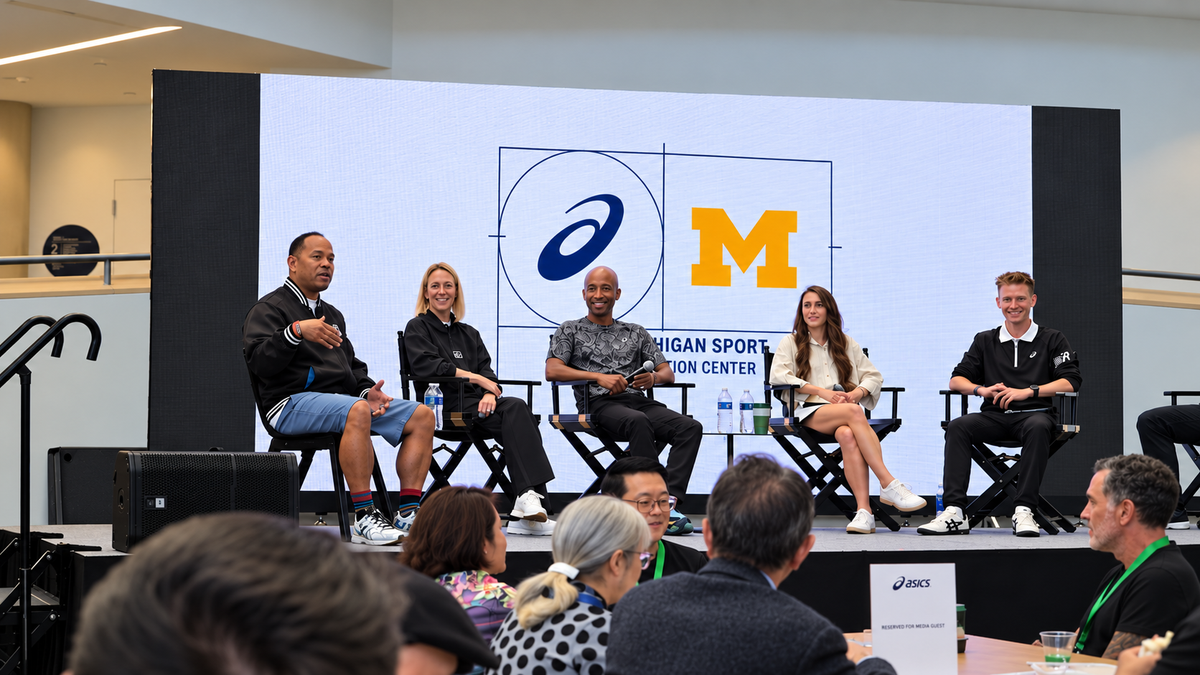
On October 22, 2026, ASICS and the University of Michigan opened the ASICS Michigan Sport Innovation Center in Ann Arbor, about an hour up US-23 from Toledo. It's ASICS's first research hub in the United States. Scientists there are studying how runners move, how shoes feel, and why the "right" shoe is different for every person. Our team was there for the opening. Here's what we saw in the labs, what the athletes had to say, and what it all means for runners in Northwest Ohio.
What is the ASICS Michigan Sport Innovation Center?
The center is a research partnership between ASICS Institute of Sport Science America and the University of Michigan. It pulls together experts in robotics, engineering, materials science, kinesiology, design and psychology. The goal is simple to say and hard to do: build running shoes that fit the way each runner actually moves and feels. ASICS has run its Institute of Sport Science in Kobe, Japan, for decades. Ann Arbor is now its home base in America. The opening day included a ribbon cutting with ASICS leaders, U-M leadership and Michigan Governor Gretchen Whitmer, followed by lab tours and a fireside chat with ASICS athletes.
Why a Lab in Ann Arbor Matters to Runners in Northwest Ohio
Toledo and Ann Arbor share a running region. Many of us race on both sides of the state line, and plenty of Southeast Michigan runners come south for the Mercy Health Glass City Marathon each spring.
That connection showed up on stage. Vincent Mauri ran a record-setting marathon debut of 2:05:54 at the Glass City Marathon, which Run Toledo operates for the Toledo Roadrunners Club. He followed it with 2:06:45 at Chicago this fall. Now he's an ASICS athlete sitting next to American running legends.
World-class shoe science is happening in our backyard. And the questions those scientists are asking are the same ones we ask on the fitting floor every day.
Turning a Phone Video into Lab-Grade Running Data
Our first stop was the U-M robotics building. It's home to a long line of walking robots, including Digit, a full humanoid built by Agility Robotics, a company that grew out of work at Michigan. The building was literally constructed around one lab. Its treadmill reaches 50 miles per hour, tilts to about 30 degrees, and is built into the foundation.
The team that teaches robots to walk is now applying those same tools to people. Their aim: take ordinary video, even from an iPhone, and turn it into a 3D model of a runner in motion.
From that model they can estimate:
-
Stride length and cadence
-
Ground contact time
-
Joint angles at the hip, knee and ankle
-
Forward lean and center-of-mass movement
-
Left-right asymmetries
In a live demo, they built a 3D model of a volunteer from about 30 seconds of video. Then they had his model reproduce a slam dunk recorded by someone else. It got a big laugh, and it proved the model was accurate enough to move like a real body.
What is Ground Reaction Force?
Every time your foot lands, the ground pushes back. That push is called ground reaction force. It shapes how you move, how much load your legs absorb, and how much energy you get back. Today, measuring it takes force plates and a lab full of motion-capture cameras. The Michigan team is working to estimate it for every stride from video alone.
That could help athletes spot overtraining, help physical therapists watch a patient move instead of an iPad, and help shoe designers build for real feet.
Why the lab isn't the real world
One point stuck with us. Running one mile on a lab treadmill looks very different from running mile 25 of a marathon. Your form changes as you tire. If researchers can collect data at mile 25 instead of mile one, the shoes built from that data should work better when it counts.
Building Better Shoes from the Yarn Up
Next we visited textile and materials labs, where every surface was meant to be touched.
Professor Sean Ahlquist's team at U-M's Taubman College designs textiles starting from the yarn itself. They control the knit structure, shape, texture and color. Some of their pieces inflate, ripple, or even blow cool air through tiny holes in knitted tubes.
He is creating an experience through how materials can feel. I've each person enough "dials" to tune comfort to exactly what they want. For a running shoe, that could mean an upper that adapts to your foot as you run.
Foam with a structure, not just a recipe
Professor Max Shtein showed us 3D-printed "metamaterials." These materials get their cushioning and bounce from their internal structure, not just their chemistry.
Squeeze most foams and they bulge out the sides. Some of these structures pull inward instead. By changing the pattern inside a midsole, designers can tune cushioning and rebound zone by zone, and potentially for each runner.
Sensors you'll never feel
Shtein's team also uses kirigami, the Japanese art of cutting paper, to turn flat sheets into flexible shapes. Flat sheets are cheap to print electronics on. Cut the right pattern, and that circuit bends to fit the body.
The goal is a shoe with sensors built in that still feels like a normal shoe. Run a 10-mile trail loop or a 50-mile ultra, and it quietly records how you and your shoe interact with the ground.
Graduate students also demoed a camera rig that follows a runner down the track and keeps their feet in frame, to capture how a shoe flexes mid-stride.
The Goldilocks problem: why "just right" is different for every runner
This was the lab closest to what we do every day.
The decision science team from U-M's Institute for Social Research studies the runner's mind. They map four connected layers:
-
Shoe design: stack height, foam, plates, materials
-
Biomechanics: cadence, stride length, gait
-
Experience: how the shoe feels, soft or firm, smooth or bouncy
-
Preference: which shoe you actually choose, and why
They call shoe preference a Goldilocks problem. One runner's "too soft" is another runner's "just right."
Your reason for running matters too. A runner chasing a marathon PR wants something different than a parent jogging a costume 5K with their kids. Even the same runner may want one shoe for an easy recovery day and another for race day.
Here's the part we loved. Many runners don't have words for what they want beyond "it should feel good." The researchers are building ways to predict what someone will prefer from how they move, so even the runner who can't describe it can land in the right shoe.
By having runners rank several shoes, they can also spot "white space": groups of runners whose ideal shoe doesn't exist yet. That's where the next ASICS shoe could come from.
What the ASICS athletes told us
The day closed with a fireside chat featuring five ASICS athletes. Their advice applies whether you run a 5K at Metroparks Toledo or a marathon on The Ribbon.
-
Deena Kastor, longtime American marathon record holder (2:19:36), credited one habit above all: optimism. She treats every setback as a lesson, not a failure.
-
Drew Hunter, who went pro straight out of high school and holds a 5,000-meter PR of 13:05.60, described his journey in one word: vulnerable. He's had public setbacks and kept showing up.
-
Nathan Martin, a Michigan native and the 2026 Los Angeles Marathon champion (2:11:16), said his biggest lesson was to focus on the process, not the goal.
-
Emma Grace Hurley, who debuted at the 2026 Chicago Marathon in 2:20:47, said her racing improved once she focused on effort instead of fearing a bad result.
-
Vincent Mauri, whose marathon career started at Glass City, said his secret is simple: have fun. He's never been happier, and his running followed.
What this means for your next pair of running shoes
Research at the center is just getting started, and new shoes take time to reach store shelves. No one is promising a custom-printed shoe next season.
But the big lesson is already true today: there is no single best running shoe. There's the best shoe for your body, your stride and the kind of running you do.
That's why fitting matters. At Dave's, we've been fitting Northwest Ohio runners since 1973. We watch how you move, ask how you run and what you want to feel, and have you try several options side by side. It's the same Goldilocks approach these scientists are now proving in the lab.
Ready to find your "just right" shoe? Visit any Dave's Running Shop in Sylvania, Perrysburg, Findlay or Delta and learn about our fit process.
Training for Glass City? Put your new shoes to work with Spring In-Training, from the official training partner of the Mercy Health Glass City Marathon.
FAQ section
What is the ASICS Michigan Sport Innovation Center? It's a research partnership between ASICS Institute of Sport Science America and the University of Michigan. Opened in Ann Arbor on October 22, 2026, it's ASICS's first research hub in the United States. Teams there study biomechanics, materials, textiles and runner preference to design better running shoes.
Where is the ASICS Michigan Sport Innovation Center? It's on the University of Michigan campus in Ann Arbor, Michigan, about an hour north of Toledo via US-23.
Can a phone video really analyze my running form? Michigan researchers are building tools that turn ordinary video, including iPhone footage, into a 3D model of a runner. From it they can estimate stride length, cadence, ground contact time, joint angles and asymmetries, data that normally requires a full motion-capture lab.
What is ground reaction force in running? Ground reaction force is the push the ground gives back each time your foot lands. It affects how much load your legs absorb and how you move forward. Researchers measure it to understand injury risk, training load and how shoes perform.
Why does a shoe my friend loves feel wrong to me? Researchers call it a Goldilocks problem. Cushioning, firmness and stability that feel just right to one runner can feel too soft or too firm to another. Your stride, your goals and the type of run all change which shoe feels best.
How do I find the right running shoe in Toledo? Get fitted in person. At Dave's Running Shop, our staff watch how you move, ask how and why you run, and have you compare several shoes side by side. Learn more about our fit process.